
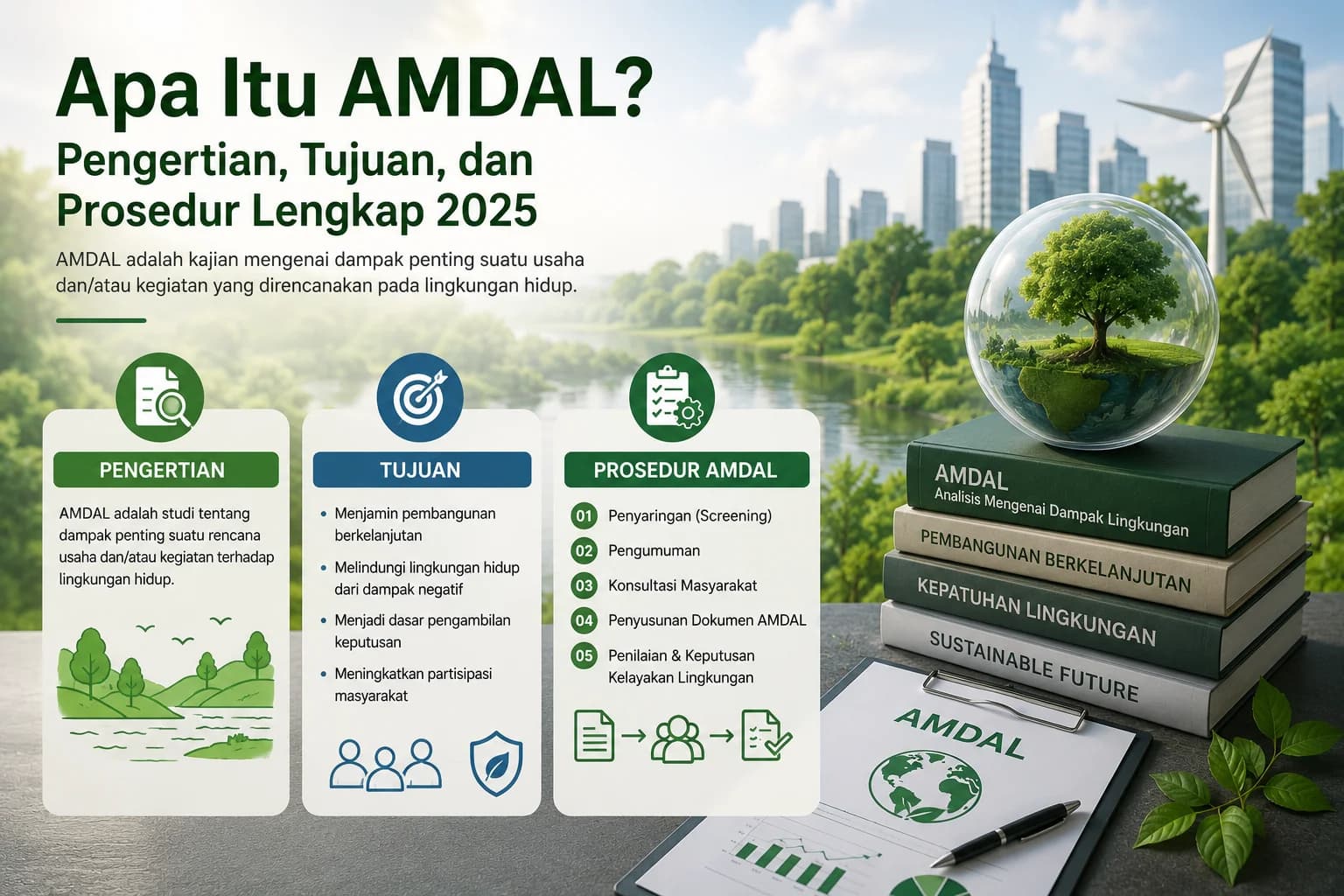
Definition of AMDAL
AMDAL (Environmental Impact Assessment) is a study of the significant impacts of a planned business and/or activity on the environment. AMDAL is required for decision-making regarding the operation of businesses and/or activities.
Based on Law Number 32 of 2009 on Environmental Protection and Management, AMDAL serves as an instrument for preventing environmental pollution and/or damage.
Legal Basis for AMDAL
The main regulations governing AMDAL in Indonesia include:
Law No. 32 of 2009 on Environmental Protection and Management
Government Regulation No. 22 of 2021 on the Implementation of Environmental Protection and Management
Minister of Environment Regulation No. 4 of 2021 on the List of Businesses and/or Activities Requiring AMDAL, UKL-UPL, or SPPL
Law No. 6 of 2023 (Job Creation) which updated several AMDAL-related provisions
Purpose of AMDAL Preparation
AMDAL aims to:
Identify environmental impacts — Determine the potential positive and negative impacts of an activity on the surrounding environment
Develop mitigation plans — Create management plans to minimize negative impacts and maximize positive impacts
Ensure sustainability — Ensure development aligns with sustainable development principles
Fulfill regulations — As a mandatory requirement for business licensing through the OSS-RBA system
Who Is Required to Prepare AMDAL?
The obligation to prepare AMDAL applies to businesses/activities that meet the following criteria:
Alter landscape or landforms
Exploit natural resources, both renewable and non-renewable
Cause pollution, environmental damage, or natural resource degradation
Affect the natural, built, social, and cultural environment
Cause impacts on natural resource conservation areas
Components of AMDAL Documents
AMDAL documents consist of several main components:
1. Terms of Reference (KA)
A document containing the scope of the AMDAL study, including determination of significant impacts to be examined.
2. Environmental Impact Statement (Andal)
A careful and in-depth analysis of significant impacts from the planned business/activity.
3. Environmental Management Plan (RKL)
A plan for managing environmental impacts generated by the activity.
4. Environmental Monitoring Plan (RPL)
A plan for monitoring environmental components affected by the impacts.
AMDAL Preparation Procedure
The general stages of AMDAL preparation include:
Application submission — The proponent registers the planned activity through the OSS system
KA Form preparation — The preparation team develops terms of reference containing the study plan
Public consultation — Involving affected communities and stakeholders
Andal and RKL-RPL preparation — The expert team conducts an in-depth study based on the approved KA
Assessment by the Feasibility Test Team — Documents are assessed by a government-appointed team
Issuance of Environmental Approval — If deemed feasible, an environmental feasibility decree is issued
How Long Does the AMDAL Process Take?
The AMDAL preparation process generally requires 4-12 months, depending on:
Project scale and complexity
Availability of environmental baseline data
Public consultation process
Speed of assessment by the review team
Why Choose a Professional AMDAL Consultant?
AMDAL preparation must be carried out by a Licensed Document Preparation Agency (LPJP) with certification. The preparation team must also hold KTPA (AMDAL Team Leader) or ATPA (AMDAL Team Member) certification.
Izin AMDAL, part of PT. Bintang Tsuroyya Bersinar, has a fully certified expert team with experience handling 500+ projects across Indonesia. We are ready to help you from initial consultation to the issuance of environmental approval.
Tags
Recent Articles