
Three Types of Environmental Documents in Indonesia
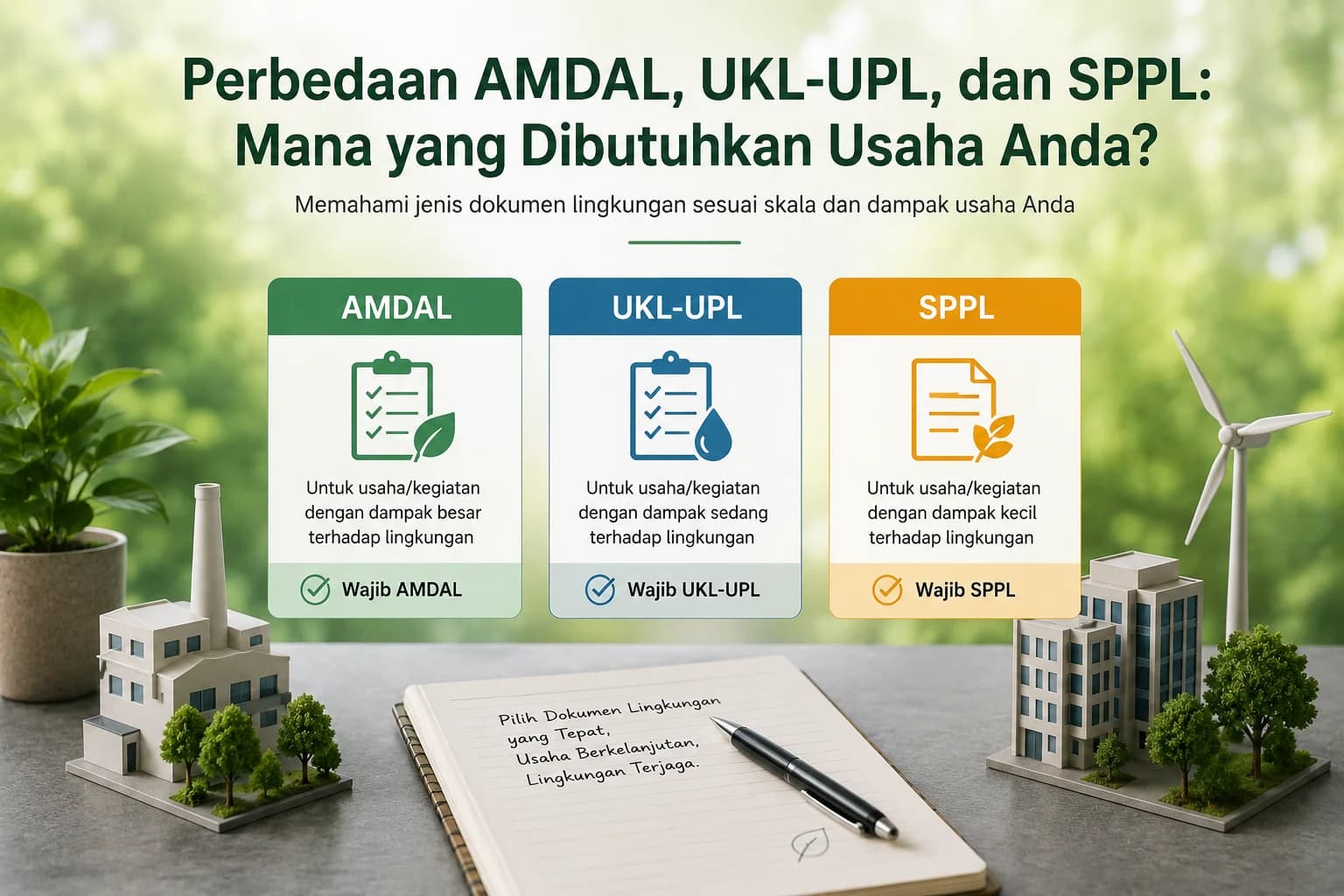
Every business or activity with the potential to impact the environment is required to have environmental documents. In Indonesia, there are three types of environmental documents grouped by risk level and impact scale:
AMDAL — for large and significant impacts
UKL-UPL — for non-significant impacts
SPPL — for low risk
AMDAL: For Large-Impact Projects
AMDAL (Environmental Impact Assessment) is intended for businesses/activities with the potential to cause significant impacts on the environment. This is the highest level in the environmental document hierarchy.
Characteristics:
Required for large-scale projects (factory construction, large-scale mining, major infrastructure)
Preparation process carried out by a certified LPJP
Goes through assessment stages by the Feasibility Test Team
Completion time: 4-12 months
Requires community involvement (public consultation)
Examples of activities requiring AMDAL:
Industrial estate development > 10 ha
Power plants > 100 MW
Metal mineral mining
Dam construction height > 15 m
Tourism areas > 100 ha
UKL-UPL: For Medium-Impact Projects
UKL-UPL (Environmental Management and Monitoring Efforts) is required for businesses/activities that are not required to have AMDAL but still have the potential to cause environmental impacts.
Characteristics:
For medium-scale projects
Can be prepared by the proponent or using consulting services
Faster process and more affordable costs
Completion time: 1-3 months
No formal public consultation required
Examples of activities requiring UKL-UPL:
Residential development 0.5-5 ha
Restaurants > 200 seats
Gas stations
Type C or D hospitals
Small-medium industries
SPPL: For Low-Risk Businesses
SPPL (Environmental Management Statement Letter) is the simplest document applicable to businesses/activities with low risk to the environment.
Characteristics:
Simplest and fastest process
In the form of a proponent's commitment statement
No in-depth study required
Completion: a few days
Very minimal cost
Examples of activities requiring only SPPL:
Micro and small businesses
Small-scale shops/retail
Small restaurants (< 200 seats)
Small workshops
Regular eateries
Complete Comparison Table
| Aspect | AMDAL | UKL-UPL | SPPL |
|---|---|---|---|
| Impact | Large & significant | Not significant | Low risk |
| Documents | KA + Andal + RKL-RPL | UKL-UPL Form | Statement letter |
| Preparation team | Certified LPJP | Consultant/proponent | Proponent only |
| Public consultation | Required | Not required | Not needed |
| Duration | 4-12 months | 1-3 months | A few days |
| Consulting cost | Rp 100-500 million | Rp 15-50 million | Free/minimal |
| Output | Environmental Approval | Environmental Approval | Registered SPPL |
How to Determine the Right Document?
Steps to determine the type of environmental document required:
Identify your business/activity type based on the classification in Minister of Environment Regulation No. 4/2021
Check the scale/magnitude of the activity (land area, production capacity, etc.)
Consult with the local Environmental Agency or an experienced consultant
Check conformity through the OSS-RBA system which will direct you automatically
Conclusion
Choosing the right environmental document is critical for smooth business licensing. Errors in determining the document type can cause application rejection or even legal sanctions.
If you are still unsure, Izin AMDAL provides a free consultation service to help determine the right environmental document for your business needs. Our expert team will analyze your activity and provide appropriate recommendations.