
If one document appears unexpectedly midway through projects more than any other, it is the traffic impact analysis.
The pattern is almost always the same. The environmental document is settled, everything feels safe, and then the building approval application asks for a traffic impact analysis. The project stalls, and the team starts from zero on something that was never in the schedule.
It is not part of the AMDAL
This is the root of the confusion. The names are similar, both are “impact analyses”, and both examine the same activity.
But they stand apart:
| Aspect | AMDAL / UKL-UPL | Traffic impact analysis |
|---|---|---|
| What is assessed | Impact on the environment | Impact on traffic and road transport |
| Agency | Environmental agency | Transport agency |
| Legal basis | Environmental protection regime | Traffic and road transport regime |
| Outcome | Environmental Approval | Approval of the traffic impact analysis |
Holding an Environmental Approval does not discharge the traffic obligation, and vice versa. Both can be prepared simultaneously, and generally should be.
When it is required
The obligation is determined by the volume of traffic your activity generates. The greater the generation, the higher the tier of document required.
Activity types that almost always trigger it:
Shopping centres and large retail developments, because of high daily visitor numbers.
Housing estates and apartments, particularly with large unit counts.
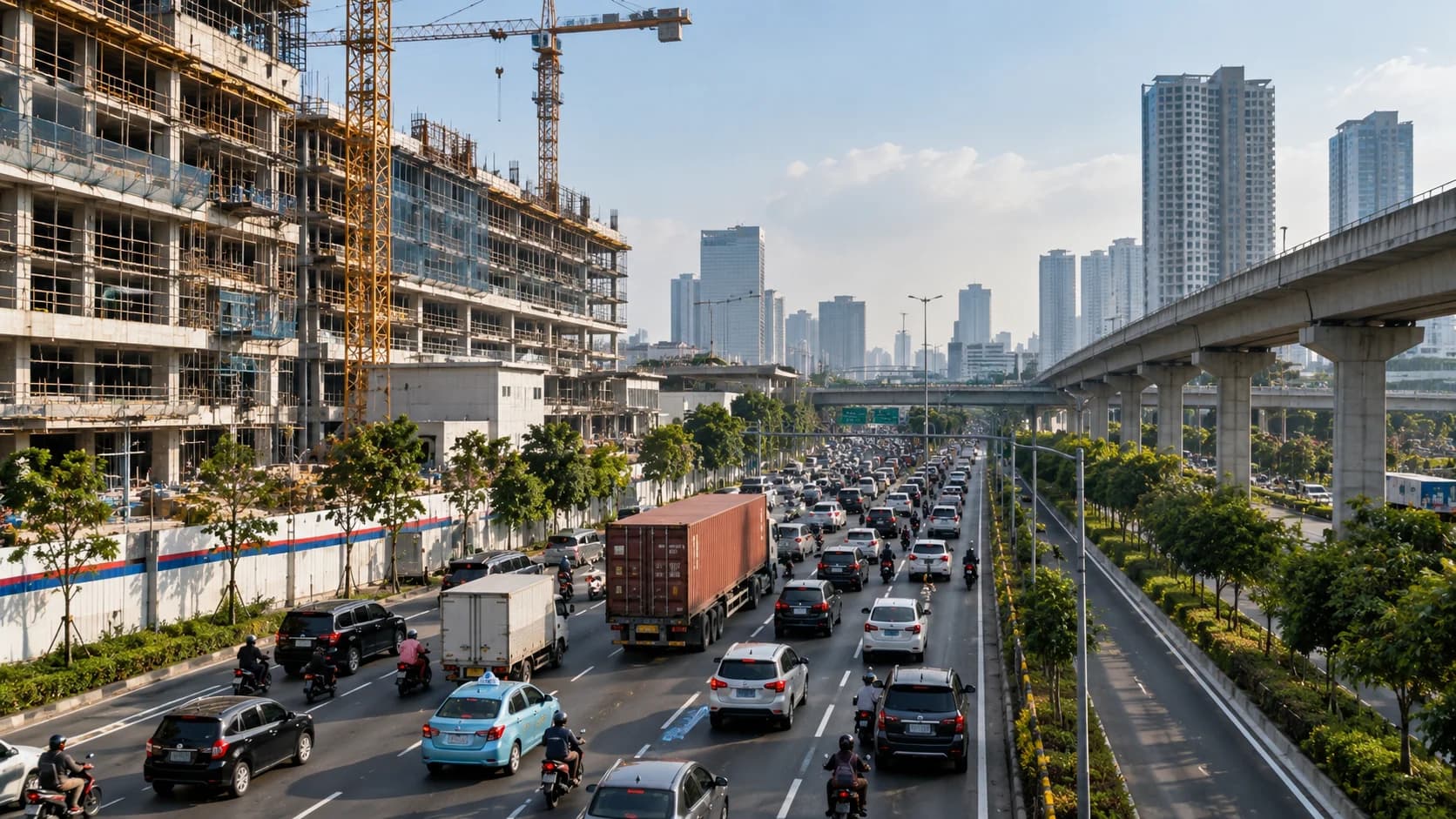
Warehouses and distribution centres, where vehicles are larger even if fewer. One container truck has a far greater effect than one private car.
Factories, combining shift-change worker traffic with goods movements.
Hospitals, hotels, schools, and campuses.
Fuel stations and terminals.
Worth noting: thresholds can differ between regions, because local governments have authority to set provisions suited to their road networks. What is exempt in one regency can be mandatory in the city next door.
What the study covers
A traffic impact analysis works by comparing conditions before and after your activity begins operating:
Existing traffic conditions. Vehicle volume surveys on surrounding road segments and intersections, at morning and evening peaks.
Projected generation. How many additional trips your activity will produce, calculated from its type and scale.
Road performance after operation. Whether the intersection outside your site can still cope, or will drop a level of service.
Mitigation plan. The section that most determines your future costs.
The part that surprises people most
The mitigation plan is not merely text in a document. It is a commitment you must implement, at your own expense.
It can take the form of widening the road outside your site, constructing a deceleration lane, installing traffic signals, providing additional parking, altering the access arrangement from what you had planned, or stationing traffic marshals during peak hours.
For some projects, the cost of traffic mitigation exceeds the cost of preparing the document. And because it attaches as an obligation, it is not negotiable once the approval is issued.
Starting the analysis early therefore has a real advantage: if the mitigation turns out to be heavy, you still have room to adjust your access arrangement or layout before everything is built.
How long it takes
For mid-scale activities, a realistic figure is one to three months from survey to approval. For large activities with complex mitigation, longer, because deeper discussion with the agency is needed.
What usually slows it is not the preparation but the negotiation over what mitigation you will commit to.
The right sequence
A traffic impact analysis connects directly to building approval. In many regions, its approval is a prerequisite for a building approval application where the activity is subject to it.
The sequence that causes fewest problems:
Conformity of spatial use.
Environmental document and traffic analysis, in parallel.
Building approval.
Construction.
Certificate of functional worthiness.
Running step two in parallel saves meaningful time, because field surveys can be coordinated and site data shared.
If the building already stands
Like an environmental document, a traffic impact analysis is fundamentally a planning document. For a building already operating without one, the approach usually becomes an assessment of existing conditions together with a plan to mitigate impacts already occurring.
The difficulty is clear: if widening an access point or reconfiguring parking turns out to be necessary, doing it on a finished building is far more expensive than accommodating it on a drawing.
A quick check
Three things are enough to estimate whether you are subject to the requirement: type of activity, its scale (unit count, floor area, or capacity), and the exact location including which road it accesses.
Send all three on WhatsApp. We will check the provisions applying in your region, which is the part that most often differs and is most often assumed incorrectly.