
Unlike AMDAL, whose price ranges are discussed openly, wastewater technical approval costs rarely have a public benchmark. Many companies therefore accept a quotation without knowing whether the figure is reasonable.
This article tries to unpack it, not by naming one number, but by showing what moves it.
What you are actually paying for
The cost is made up of several parts, each quite different in nature.
Technical study
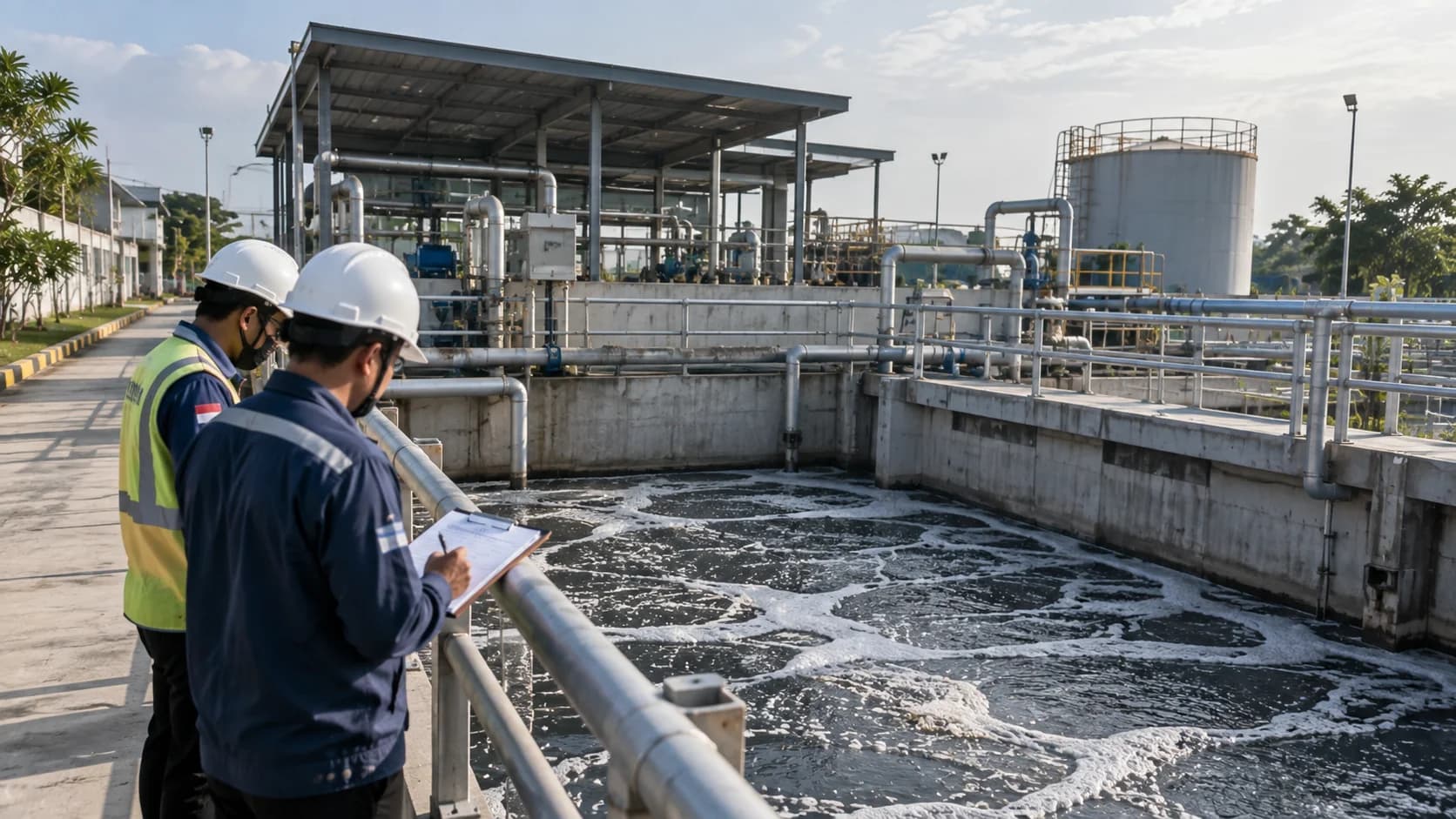
The core of the work. Building a water balance, calculating pollutant loads, designing treatment units and their dimensions, and setting out calculations that can be defended before a technical team.
Its size depends on the complexity of your process. An activity with one wastewater stream of uniform character is far simpler than a plant with several different streams that must be combined or separated for treatment.
Laboratory testing
Charged per parameter per sample, with the parameter list following your activity type rather than preference. For activities involving heavy metals or specific organic compounds, this can be the largest component.
Two rounds of testing are needed: characterisation of raw wastewater for the technical approval, and testing of treated effluent for the operational certificate.
Assessment support
Responding to the technical team's questions, revising the document, explaining the basis of calculations. Frequently undervalued, and the biggest determinant of how long the process takes.
What is usually not included
Construction of the plant itself. This needs stating because it is quite often misunderstood. A technical approval is approval of a design; building it is separate construction work with its own, usually much larger, cost.
Five factors that move the figure most
Wastewater flow rate. The larger it is, the larger the units designed.
Wastewater character. Domestic wastewater is far simpler than process wastewater containing heavy metals, oil and grease, or specific chemicals.
Number of parameters to be tested. Multiplies directly into laboratory cost.
Whether a plant already exists. Designing from nothing differs from evaluating an existing plant and preparing an upgrade plan.
The receiving water body. Discharging into a water body with limited assimilative capacity demands deeper assessment and tighter quality standards.
How long until the certificate is issued
A realistic picture:
| Stage | Estimated time |
|---|---|
| Data gathering and initial characterisation | 2–4 weeks |
| Preparation of the technical study | 3–6 weeks |
| Assessment and revision until approval issued | 1–3 months |
| Construction or upgrade of the plant | Depends on construction scope |
| Effluent testing and certificate application | 3–6 weeks |
The fourth row is the hardest to forecast, because it depends entirely on the scale of construction work.
One thing that saves meaningful time: since Government Regulation 28 of 2025, the technical approval can be filed in parallel with the Environmental Approval. For new activities, using this can cut several months compared with running them sequentially.
Sensible ways to reduce cost
Prepare the data yourself. Water balance, process flow diagram, equipment specifications, piping layout. If your internal team prepares these, consultant time drops considerably.
Separate waste streams at the design stage. Mixing process wastewater with rainwater or domestic wastewater increases the flow requiring treatment, which raises both construction cost and operating cost permanently. Separating them at the outset is the single largest long-term saving available to you.
Run it alongside the environmental document. One survey, one team, shared data, and most importantly, figures guaranteed consistent across both documents.
Do not trim test parameters. This is a false saving. Omitted parameters will be requested during assessment, and repeat testing means added time on top of added cost.
Costs that continue after the certificate
The part most often missing from annual budgets.
Once the certificate is issued, periodic monitoring obligations apply at the prescribed frequency. For activities with monthly obligations and many parameters, a year of testing can approach the cost of preparing the document itself.
Add the plant's operating costs: chemicals, electricity, sludge handling, and maintenance. Budgeting for these at the start is far better than discovering them as a surprise in the first year of operation.
An estimate for your activity
To give a reasonably close cost picture, only three things are needed: type of activity, estimated wastewater flow per day, and discharge destination.
Send those three on WhatsApp. If it turns out your activity generates only domestic wastewater and does not require a technical approval, we will tell you that from the outset.